by Emilio Sauri
Northwestern University Press
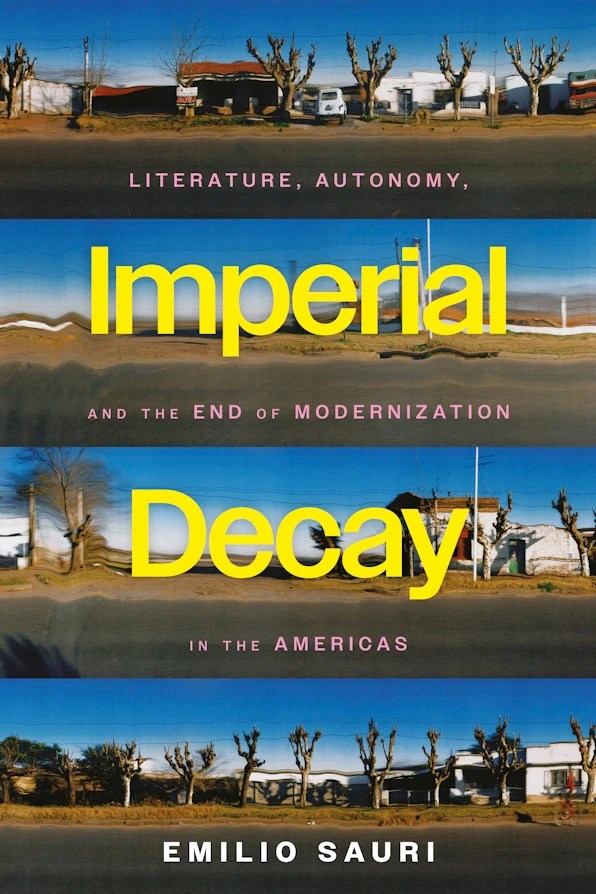
Demonstrating how art and literature remain vital to alternative imaginaries beyond the power of imperialism and modernization
Imperial Decay: Literature, Autonomy, and the End of Modernization in the Americas employs a dynamic, comparative approach to contemporary literature and visual art, showing how fiction, photography, poetry, and film from Latin America and the United States vividly illuminate the present. Focusing on the period from the end of the Cold War to the financial crisis of the late 2000s, Emilio Sauri contends that what brings these media together is not just the history of hemispheric connections but also, and more strikingly, the question of the artwork’s autonomy.
Elaborating on influential accounts that reveal how US hegemony in Latin America and the resistance it inspired throughout the region are bound up with the promise of modernization, Imperial Decay offers unique insights into the hollowing out of this promise at the end of the so-called American Century. Tracing this commitment back to the modernisms of the last century and forward to more recent works, this book casts canonical figures such as Ernest Hemingway, Walker Evans, and Gabriel García Márquez in a new and necessary light while developing a compelling interpretive framework for contemporary writers and artists from across the region, including Roberto Bolaño and Benjamin Kunkel, Alejandro Cartagena and Yvonne Venegas, and Kleber Mendonça Filho. Ultimately, Sauri shows why the work of art remains vital to the task of envisioning alternatives to the immiserations, ecological devastation, and degraded forms of life wrought by imperial decay.
 Mexican Studies Research Collective
Leave a reply to Larson, Susan Cancel reply